An official website of the State of Georgia.
Posted December 1st, 2025
Coastlines Georgia | December 2025 | Vol. 8, Iss. 3
Participants keep eye on future while discussing broad swath of topics
Tyler Jones
Public Information Officer

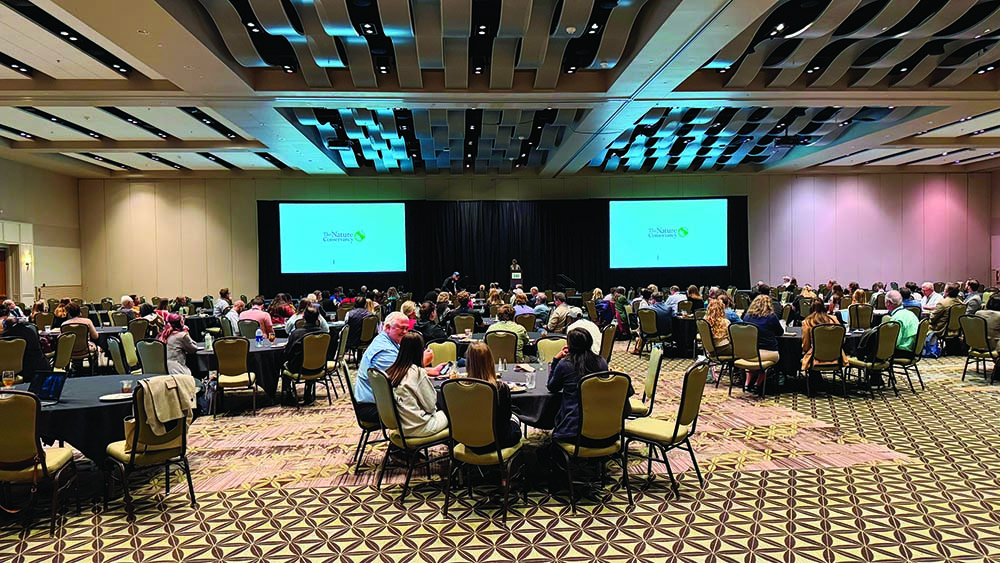
When coastal Georgians talk about resilience, they’re not trading in buzzwords. Along our barrier islands and marsh-lined rivers, resilience is something you can feel—salt marsh grass bending in the wind, communities rallying after storms, agencies learning from the last high tide to prepare for the next. That spirit was at the center of the Georgia Resiliency Conference, held Oct. 20–21 on Jekyll Island, where CRD brought together scientists, planners, emergency managers, engineers, educators, and local officials to talk about preparing our coast for the changes ahead.
Hosted against the backdrop of Jekyll’s quiet beaches and sprawling live oaks, the two-day event served as both a working meeting and a reminder of what’s at stake. More than 300 attendees, from Glynn County commissioners to state and federal partners, spent the conference trading ideas, comparing data, and building new relationships across agencies and disciplines. The goal was simple: ensure Georgia’s coastal communities have the tools, science, and strategies they need to withstand rising seas, stronger storms, and the rapid pace of coastal development.

CRD’s Jim Long and Jan Mackinnon speak in between panel sessions.
CRD Director Doug Haymans said the conference was about highlighting the importance of collaboration. “No single agency or community can tackle coastal resilience alone,” he said. “Success comes from working together—local knowledge, state support, federal expertise, and the on-the-ground partnerships that make ideas real.”
The conference moved through a fast-paced slate of presentations and workshops. Researchers from the Georgia Southern University shared the latest findings on marsh migration and shoreline erosion. CRD biologists discussed new tools for assessing the health of tidal creeks and oyster reefs—habitats that act as natural buffers during storm surge. Planners from coastal communities talked about their own challenges: aging stormwater systems, high-tide flooding in places that never used to flood, and the rising cost of disaster recovery.

From left, CRD’s Diana Patrick, Cheyenne Osborne, Jim Long, Jennifer Kline, and Shy Duncan man the welcome booth at the Georgia Resiliency Conference.
One of the most talked-about sessions came from state agency officials, who represented not just DNR, but the Georgia Emergency Management Agency, and Department of Transportation. Together, these officials looked at the impacts of climate change through the lenses of energy usage, emissions, beneficial use of sediment projects to create habitat, and even computer modeling.
But the conference wasn’t all maps, charts and models. It also highlighted success stories—projects that show what resilience looks like when partners work together. Attendees heard about living shoreline installations in McIntosh and Chatham counties, marsh restoration projects supported by the Georgia Outdoor Stewardship Program, and local governments finding creative ways to elevate roads, redesign drainage basins, and protect vulnerable neighborhoods. These examples served as real-world reminders that resilience isn’t abstract. It’s practical, tangible, and increasingly urgent.
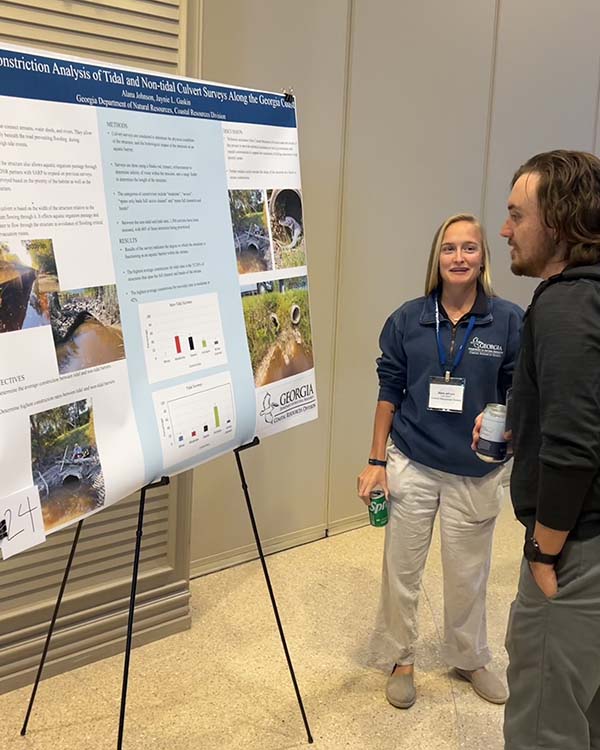
Wetlands technician Alana Johnson, left, shows off her poster display during the Georgia Resiliency Conference.
A broad expanse of expertise was present at the conference, which featured more than 120 speakers. Although they came from different backgrounds and fields, and even as far away as Atlanta and Columbus, the panelists agreed on one thing: Georgia’s coast is changing, and the state’s response must change with it.
As attendees filtered out beneath Jekyll’s twisting oaks, the feeling was hopeful. Not because the challenges are small, but because the people facing them are committed. In a world where coastal issues often feel overwhelming, the Georgia Resiliency Conference offered something rare: a reminder that resilience doesn’t happen by accident. It’s built—patiently, collaboratively, and one coastal community at a time.