An official website of the State of Georgia.
About
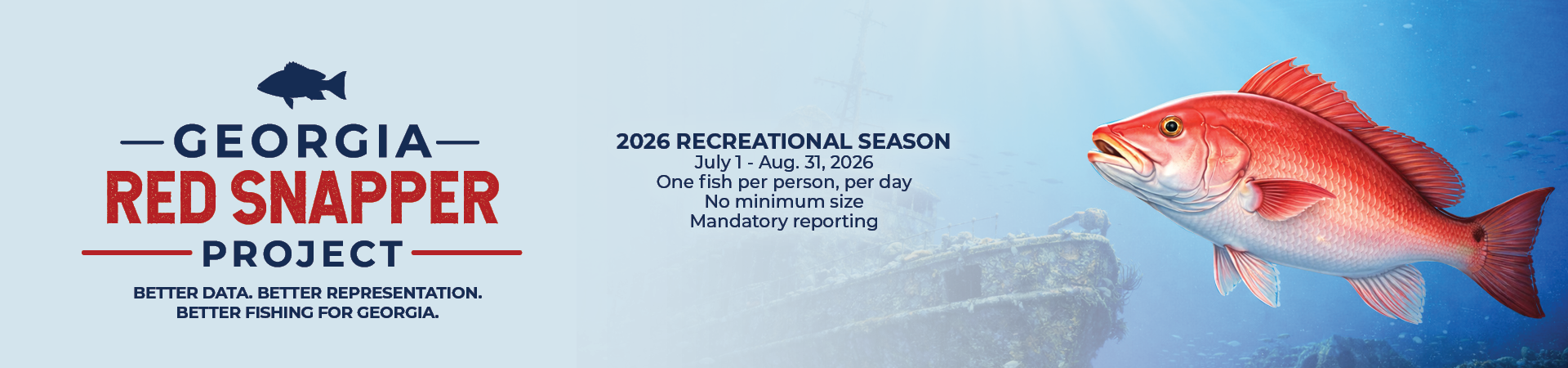
The Georgia Red Snapper Project is a new initiative from the Georgia DNR Coastal Resources Division that opens a 62-day recreational red snapper season, July 1 through August 31, 2026, in federal waters off the Georgia coast.
More information will be available at GeorgiaRedSnapper.com when a new website launches May 15, 2026.
62-Day Season
July 1 - August 31, 2026. After 15 years of one- and two-day federal seasons, Georgia anglers now have two full months on the water.
Reporting Information
The project is being implemented through a federal Exempted Fishing Permit (EFP) that Georgia requested from the U.S. Secretary of Commerce in November 2025. The EFP allows Georgia to bypass federal regulations for 2026. If Georgia can show it can collect better data, the EFP could possibly be extended for two additional years. Three other Southeast states, North Carolina, South Carolina, and Florida, collaborated with Georgia in their own EFP applications.
Together, the states seek to test new approaches for collecting more accurate, real-time recreational fishing data on red snapper.
Under the Georgia Red Snapper Project:
- Recreational anglers will have a two-month red snapper season in federal waters off Georgia beginning July 1, 2026, and ending Aug. 31, 2026
- Anglers may keep one fish per person per day
- There is no minimum size per fish
- All participating anglers must register their trips prior to departure using a free mobile or desktop app soon to be available
- Anglers must report their catch within 24 hours
- More information, including how-to videos and the downloadable app will be available soon
- Mandatory reporting is a critical component of the project. Anglers will create a trip ticket before departing for their fishing trip (up to five days in advance) and report harvested and released fish within 24 hours. An angler can expect to spend just a few minutes sending a report.
By pairing increased access with improved reporting, the Georgia Red Snapper Project aims to demonstrate that longer, more stable seasons are achievable when high-quality data are available.
The initiative is supported by a $300,000 grant from Yamaha Rightwaters, a conservation program from Yamaha Motors focused on sustaining marine resources and recreational fishing opportunities.
Descending Devices
Since July 15, 2020, NOAA Fisheries requires anglers targeting snapper-grouper species, including Red Snapper, to have descending devices rigged and ready to use onboard the vessel. Descending devices help reduce discard mortality in fish.
When an angler reels in a Red Snapper quickly from more than 30 feet, the fish may experience a syndrome known as barotrauma. This syndrome causes the fish's swim bladder to expand too rapidly, which can result in its internal organs bulging out of the fish's mouth. If the fish is discarded and returned to water, it will be unable to swim back down to depth, and is frequently subject to predation.
Descending devices can help reduce barotrauma by rapidly sending the fish back down to the depth at which it was caught. Returning to proper depth will reduce the effects of barotrauma and greatly increase its chance of survival.
For more information about descending devices, visit CoastalGaDNR.org/FishSmart.
Citizen Science - Carcass Recovery Project
Coastal Resources Division takes advantage of the fishing efforts of hundreds of anglers by turning filleted fish carcasses that anglers would normally discard into a source of much-needed data on Georgia’s marine sportfish.
You can help us better understand the health of Red Snapper populations by donating the carcass after filleting the fish. We will use the carcass to remove its ear bones, which tell us the age of the fish, and we will also determine the sex and other characteristics that help in future fishery management.
To find a freezer near you and donate your Red Snapper carcasses, visit CoastalGaDNR.org/MarineCarcass#freezer.
For more information about the Marine Sportfish Carcass Recovery Project, visit CoastalGaDNR.org/MarineCarcass.
For more information specifically about red snapper data collection, visit CoastalGaDNR.org/RedSnapperData.